A team

At the beginning of 2012, the Solar Impulse team was about 90 strong, including 30 engineers, 25 technicians and 22 mission controllers, supported financially and technologically by over a hundred partners and advisers. And yet the team could have been limited to just twenty people.

 

To achieve that, an aircraft manufacturer would have had to accept being a sub-contractor responsible for building the solar airplane after completion of the feasibility study. But none of them believed it to be possible, so it was necessary in record time to create a production unit and assemble a technical team. The two founders shared the work-load, with André taking responsibility for the team and the construction work, whilst Bertrand travelled the world promoting the project and searching for partners.

Timeline

ACROSS AMERICA 2013: SAN FRANCISCO TO PHOENIX

Where’s the rest of the Solar Impulse team?

If you’ve been watching Solar Impulse TV during today’s flight, you maybe got a feel for the size of the team. Ground Crew and Logistics teams are in the US, ensuring that flights are carried out smoothly from takeoff to landing. The Marketing & Communications team and the Mission Control Center folks (who include ...

Read more

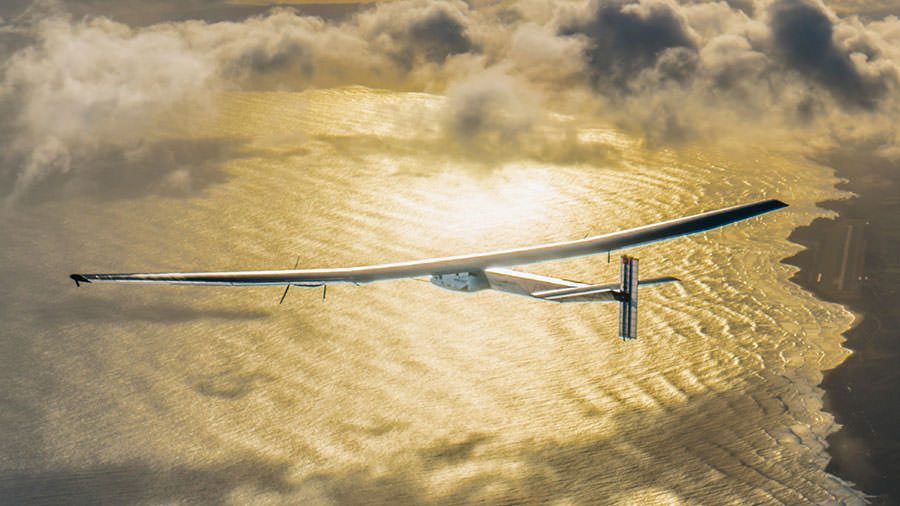
If you’ve been watching Solar Impulse TV during today’s flight, you maybe got a feel for the size of the team. Ground Crew and Logistics teams are in the US, ensuring that flights are carried out smoothly from takeoff to landing. The Marketing & Communications team and the Mission Control Center folks (who include meteorologists, Air Traffic Controllers and the Flight Director) are all in Payerne (Switzerland) guiding the pilot in the air with all sorts of programs and satellite connection devices. And there’s the multimedia team, split between two continents, Old and New, keeping us entertained and connected as the sleek silhouette of HB-SIA glides through the North American skies. But where are the engineers?

We’ve hidden them in a quiet place, where the skies are always grey and common distractions are scarce… in the suburbs of Zurich. We have to make sure they don’t escape, right? Jokes aside, the men and women that together have contributed to build HB-SIA are all extremely busy making a new airplane: Solar Impulse’s second generation solar-powered aircraft, HB-SIB. Indeed, if you thought the adventure was going to end with a graceful landing at New York’s JFK airport this summer, you were mistaken. The adventure will continue with the flight around the world scheduled for 2015.

The design phase of HB-SIB’s construction is complete and the Solar Impulse engineers are now busy testing parts in preparation for the assembly, scheduled for the end of 2013. Just a couple of weeks ago there was the Iron Bird – designed to test the electric wiring and overall electronics in a mock cockpit. Everything was setup as if it were the “real thing” with the hundreds of wires pulled through the full structure of the cockpit. Each part is initially tested separately, but in a complex electric system with different machines and a number of variables in play it is important to verify how everything interacts. The tests were successful. The four motors were running at 300 rpm at the same time as the other systems, such as the driver, the batteries and the balancers. A few other tests are still scheduled and, once everything is given a green light, it will be transposed as is to HB-SIB’s cockpit.

If you want to more about the Making Of HB-SIB, click here

EPISODE IV: THE MAKING OF A SOLAR AIRPLANE

Discussing to perfection

Just like the eternal to and fro between civil engineers and architects to find the best balance between design and a physically viable structure, a constant discourse goes on between the Design and Structural Analysis teams at Solar Impulse. The difference is that they’re all engineers, so no need to fix wacky structures ...

Read more

Just like the eternal to and fro between civil engineers and architects to find the best balance between design and a physically viable structure, a constant discourse goes on between the Design and Structural Analysis teams at Solar Impulse. The difference is that they’re all engineers, so no need to fix wacky structures that can only exist in cartoons.

Everything that’s designed has a purpose but every part needs to fit in the greater scheme of things while also abiding to the strict lightweight guidelines. Led by Geri Piller, the Structural Analysis team consists of 4 engineers. The Design team has the concept, but it’s up to Geri’s team to decide which and how many materials to use for a given part in relation to the load that it must carry.

Geri once gave me a 101 Structural Analysis course (I would have certainly done better at reading a Chinese newspaper though), but I did manage to retain something: every material reacts differently to loads (for example, steel reacts to stress differently than carbon) and this is crucial when building a part.

For reasons of weight, the majority of HB-SIB’s structure is made out of carbon, a very peculiar material. Carbon is extremely resistant in the direction of its fibers, but extremely frail in the other. The Structural Analysis team has to decide in which direction the fibers must be placed, how thick each layer has to be and how many plies are needed. This results in complex manipulations with a specialized software (FEA finite element analysis) where the structural engineers manually input the characteristics they want and subsequently observe how the part reacts to the expected loads applied to it.

It’s not a linear process (it takes two to tango). It’s a constant back and forth between structural and design engineers, an ongoing discussion to reach perfection because, once the design and structure make the perfect match, the part is finally sent to the producer; a joint effort that gives birth to a new part. Because of the unique nature of this aircraft, every part is literally handmade. Consequently, some information can be lost in translation when transforming the software design into a manufactured part. That’s why every part needs to be tested thereafter; a crucial process Geri and his team actively engage in. Stay tuned for information about the Testing team coming soon on our blog!

In the photos: from left to right: Björn Müller, Stefan Pfammatter, Geri Piller and Dominik Dusek (adjacent), Geri Piller (bottom), FEA (top).

Follow the series here: "THE MAKING OF A SOLAR AIRPLANE"

EPISODE III: THE MAKING OF A SOLAR AIRPLANE

Keeping the puzzle together

Before building anything there needs to be a concept and a design. Like when you build a house: you think about its location, its size, its architectural design and, most ...

Read more

Before building anything there needs to be a concept and a design. Like when you build a house: you think about its location, its size, its architectural design and, most importantly, the thickness of your wallet. You obviously can’t start with the roof without a foundation and you certainly can’t install the bathroom without first connecting the drain pipe to the grid.  

Once the parts are designed, who puts the puzzle together in a timely and coherent manner? Someone has to see the big picture, juggling deadlines, budget and production. At Solar Impulse, that role is attributed to Robert Fraefel, Head of Airplane Development.

Röbi, as the team likes to call him, is the man behind the scenes, the choreographer of it all. He motivates the engineers, encourages them when obstacles arise and stimulates them to pick up the pace when a deadline is approaching. He’s also somewhat of a public relations figure, meeting with dozens of suppliers and producers to seek their collaboration and ensure their deliveries meet the strict quality requirements.

An engineer with a Formula 1 background, Röbi immediately found himself in his element working for a project that pushes the boundaries; but the parallel ends there. At Solar Impulse it’s hard to plan because “we don’t know how long it takes to develop a part until it’s ready for production”. At Formula 1 “you already know, more or less, how many parts you need, how they will look like”; you always have a starting block as opposed to Solar Impulse.

When I think about the number of factors and variables involved in the construction of such a unique aircraft, I can’t help but wonder how Röbi’s hair hasn’t turned grey yet. Between the engineers in Dübendorf and Payerne, he has to regularly commute between the French and German-speaking regions of Switzerland to ensure everything is evolving smoothly.

“You have to start with something even without knowing the whole story and just go step by step.” Revealed Röbi during one of our conversations, “we tend to want to know everything from the beginning, but we have to just take the first step, advance a little and then go forward to the next keeping the target in your head.” That’s Solar Impulse’s philosophy: step-by-step and we eventually get there. 

Just as when André and Bertrand were already thinking of flying a solar aircraft without even having the hardware, Röbi started working on the project 7 years ago not knowing if it would actually be able to fly; but step by step…

Follow the series here: "MAKING OF A SOLAR AIRPLANE"

EPISODE II: THE MAKING OF A SOLAR AIRPLANE

How do you design a solar airplane?

“If you have to give something a shape, you first have to think of the space you have to build it in.”

This is the starting block of Solar Impulse’s design team. It’s just like when you move into a new home; you look at the house plan, imagine the space you have available and decide which piece ...

Read more

“If you have to give something a shape, you first have to think of the space you have to build it in.”

This is the starting block of Solar Impulse’s design team. It’s just like when you move into a new home; you look at the house plan, imagine the space you have available and decide which piece of furniture fits where, seeking the most practical but also most esthetic setting. Jonas Schär, and his team of designers do pretty much that: a sort of “interior design” of the airplane’s silhouette – and the silhouette, as we have seen in the first article of this series, is given by the concept.

Led by Jonas Schär, Solar Impulse’s Design team consists of seven people who are responsible for defining every minute detail of the aircraft. The guiding maxim is that the aircraft should be able to fly hence, every component must be carefully studied, first separately and then as a whole, religiously abiding to the maxim. Consequently, this means that everything must be designed to be as light as physically possible.

I like to think of the designers as the magical funambulists because they have absolutely no margin for error in “furnishing” the aircraft silhouette’s “empty” space. Every component has to fit into the overall restrictive weight requirements while also fulfilling its own proper function as efficiently as possible.

Each member of this team is assigned a component of the aircraft which they bring to life via 3D engineering software. Believe me, although I’m not an engineer myself, seeing the virtual 3D drawing of an airplane’s part spinning at all angles on the computer screen is simply cool. Unfortunately, every time they show me a new component, I inevitably unveil my ignorance and ask “where does this part belong”? It seems my passion for Legos as a child did not provide me with the necessary skills to meet the particular requirements for this seemingly unsolvable puzzle.

If designing HB-SIA was unbelievably difficult because of it being the first aircraft of its kind, the challenge is even greater for HB-SIB. Why you ask? Optimizing an already good system is a brain-teaser in of itself requiring a good degree of skill, physics, common sense and good “interior designer” intuition. What a cocktail!

But jokes aside, HB-SIB might look like HB-SIA; but the similarities end there. HB-SIB will not only be 11% larger, but many other features have evolved starting from the wingspan, the motors, the pilot’s equipment and the size of the cockpit.

Asking Jonas how he felt when he was told he would be building the solar airplane of its kind: “I didn’t fully realize it back then. I was maybe young enough to just proceed forward and come-up with ideas to make things happen. But I was never alone, and it’s still the case.”  He isn’t in fact alone, aside from the necessary information exchange between teams; the aircraft’s design is a team result of (in the photo, from left to right starting from back): Pascal Barmet, Frederick Tischhauser, Michael McGrath, Jonas Schär, Oliver Ensslin, Simon Bodmer, Lukas Staub and Martin Meyer.

Abracadabra!


Follow the series here: "MAKING OF A SOLAR AIRPLANE"

EPISODE I: MAKING OF A SOLAR AIRPLANE

How to conceive a solar airplane

This is the first of a series of articles about the construction of Solar Impulse’s second generation aircraft, HB-SIB, providing a step-by-step “behind the scenes” presentation. More specifically, I will introduce the different teams involved in the project. I will start from the first step necessary for the development ...

Read more

This is the first of a series of articles about the construction of Solar Impulse’s second generation aircraft, HB-SIB, providing a step-by-step “behind the scenes” presentation. More specifically, I will introduce the different teams involved in the project. I will start from the first step necessary for the development of a solar airplane: the concept. Why does HB-SIA look the way it does? And how will its big brother look like? These questions, although seemingly simple, required careful research and analysis.

I had a chat with Peter Frei, Head of Conceptual Design and Aerodynamics at Solar Impulse. A friend of André’s from their days in the Swiss Air Force, Peter Frei has been on the project from the start. He participated in the first meetings at the Federal Polytechnic University in Lausanne (EPFL) where simulations and calculations confirmed that HB-SIA would have to be an airplane and not in airship in order to fly with solar energy alone. 

Designing an airplane is a multidisciplinary process. It starts from a set of specifications given by the person with the idea and objectives. Bertrand wanted to fly around the world solely on solar energy. To achieve this, the engineers already had an indication about the power source, the flight specifications (to fly across Oceans, for example) and the minimum weight requirements such as: a manned solar aircraft able to fly at night, with batteries capable of storing energy, with provisions for the pilot, and so on. The general concept trigged Peter’s curiosity, convincing him to use his extensive engineering experience to find solutions for these strict requirements. Curiosity and creativity, as well as team work, are the key ingredients for designing an initial concept. Ideas must be challenged and the only way to find lighter, cheaper and more efficient solutions is to engage in critical thought with others.

Jotting down the first concept for a solar aircraft is a long process and many people need to be involved. For HB-SIB this process took over a year while for HB-SIA it took even longer because it was the first of its kind. Three dimensional sketches and simple hand calculations are the tools these skillful men start with to adequately develop ideas for further discussion in an engineering team.

Peter was always fascinated by airplanes. Even as a child he used to build models. It’s the physics behind flight vehicles that intrigue him and one of the main reasons why working to develop the world’s first solar aircraft to fly day and night was an inspiring feat. Him and one of his former students, Roger Ruppert had to decide how far they dared to extrapolate their experience with ultra-light materials and how large of a wing span they were prepared to handle in reality, conscious that they had to go beyond  the size of existing airplanes.

Although HB-SIA and HB-SIB will visibly be from the same family, they remain fundamentally different. The new airplane is an optimized and more complex version of its older brother. It will be larger (by 11%), it will be able to carry more weight, it will be more resistant to humid climates and, most importantly, the pilot will be much more comfortable during some of the longer legs, which could last up to several days. But you will discover these differences in the upcoming series, so stay tuned!

Follow the series here: “THE MAKING OF A SOLAR AIRPLANE”

IVAN C. KINCHELOE AWARD

Test Pilot Markus Scherdel receives the Iven C. Kincheloe award

On 29 September Markus Scherdel was awarded the Ivan C. Kincheloe prize by the Society of Experimental Test Pilots (SETP) in Anaheim, California. The award is offered each year to outstanding professionals and members of the SETP ...

Read more

On 29 September Markus Scherdel was awarded the Ivan C. Kincheloe prize by the Society of Experimental Test Pilots (SETP) in Anaheim, California. The award is offered each year to outstanding professionals and members of the SETP that have conducted remarkable test flights.

As Solar Impulse’s test pilot, Markus was the first to have proven that the aircraft can fly. It was a memorable moment when, in the icy month of December 2009, Markus sat in HB-SIA’s open cockpit (the canopy was yet to be installed), initiated the aircraft’s propellers and began to advance on the runway. In just a few moments, the prototype made what could seem like a small jump of joy: Solar Impulse did its first flea hop!

As soon as it was established that HB-SIA could indeed lift itself off the ground, Markus proceeded to take it for its first outing on 7 April 2010. The maiden flight lasted 87 minutes and went up to an altitude of 1’500 meters. Markus undertook a number of maneuvers meant to test the airplane’s reactiveness to certain commands, the responsiveness of the engines and the landing gear. If anybody watched the flight, they would have seen what looked like the world’s first aeronautic convertible because, devoid of the canopy, the cockpit was just a metal skeleton with a pilot in the center. Brrrr!

But Markus didn’t suffer from the cold or from attacks of kamikaze flies. As he mentions in his interview , he might have just had a slight feeling of victory similar to that of an Olympian and I don’t blame him: HB-SIA, a prototype initially designed to fly day and night has entered the annals of history as the first solar airplane to connect two continents: Europe to Africa


Get more content